FDA 510(k) User Fees for FY 2026
A 510(k) submission to the FDA costs a minimum of
$26,067 in FDA user fees for FY 2026
($6,517 for small businesses), plus establishment
registration ($11,423) and regulatory consultant preparation.
Total costs typically range from $30,000 to $150,000+
depending on device complexity and testing requirements.
The FDA charges a mandatory user fee for every 510(k) submission.
The fee must be paid in full before the FDA begins its review -
without payment, the submission is placed on "User Fee Hold."
Fees apply equally to Traditional, Abbreviated and Special 510(k)s.
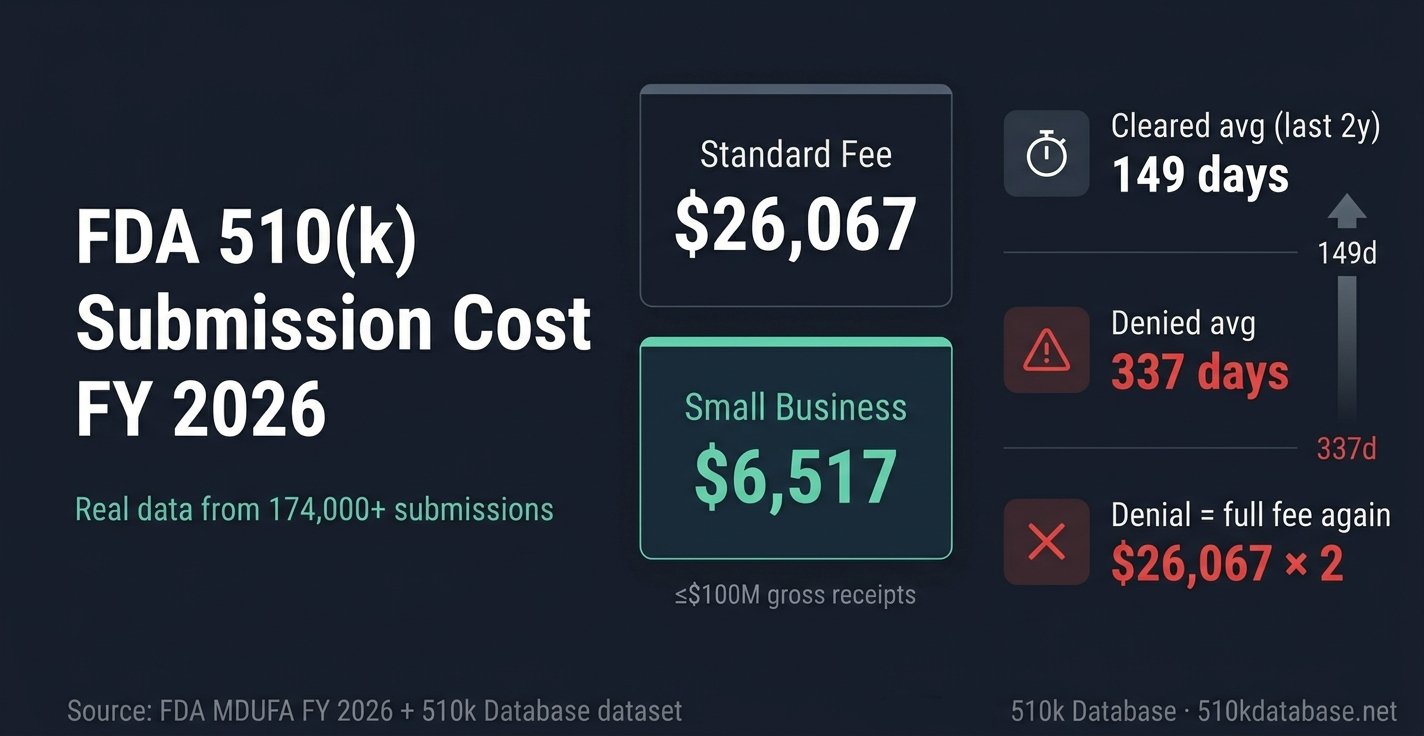
For FY 2026 (October 1, 2025 – September 30, 2026), the official
FDA 510(k) user fees are:
| Fee Type |
Standard |
Small Business† |
| 510(k) Premarket Notification |
$26,067 |
$6,517 |
| Annual Establishment Registration |
$11,423 |
Waiver possible‡ |
| De Novo Classification Request |
$173,782 |
$43,446 |
| PMA (Premarket Approval) |
$579,272 |
$144,818 |
† Small business fee applies to companies with gross receipts ≤ $100M certified by CDRH's SBD Program.
‡ Registration fee waiver available for companies with gross receipts ≤ $1M demonstrating financial hardship.
Source:
FDA MDUFA User Fees FY 2026.
FDA 510(k) User Fee History
FDA user fees are updated annually each October under the MDUFA program.
The 510(k) fee has increased significantly since MDUFA V took effect in FY 2023:
| Fiscal Year |
Standard Fee |
Small Business |
| FY 2026 (current) |
$26,067 |
$6,517 |
| FY 2025 |
$24,336 |
$6,084 |
| FY 2024 |
$22,248 |
$5,562 |
| FY 2023 |
$19,870 |
$4,967 |
Source: FDA Federal Register notices. FY 2026 fees apply October 1, 2025 – September 30, 2026.
The 510(k) fee increased 31% from FY 2023 to FY 2026 under MDUFA V.
Small Business Fee Qualification
Companies with gross receipts or sales of $100 million or less
in their most recent federal income taxable year qualify for the reduced
small business fee - a 75% reduction from $26,067 to $6,517.
Qualification requires certification through the CDRH Small Business
Determination (SBD) Program. Foreign businesses must submit Form FDA 3602A.
Fee Exemptions
No user fee is required when: the 510(k) is reviewed by an
FDA-accredited third-party reviewer; the device is intended solely
for a pediatric population; or the submitter is a state or federal
government entity and the device will not be commercially distributed.
Refunds
The FDA will refund the fee if the submission fails to pass acceptance
review (Refuse to Accept) and you choose to withdraw - but
will not refund once the submission is accepted for
review. A resubmission after withdrawal always requires a new fee.
FDA 510(k) Review Timeline - Real Data from the Dataset
The FDA user fee is only part of the total cost of a 510(k)
submission. Review time represents a significant indirect cost -
every additional month in review means delayed market entry,
continued R&D spend and deferred revenue.
| Metric |
Days |
Note |
| All-time median (cleared) |
129d |
175,000+ records |
| Last 2 years avg (cleared) |
149d |
Recent trend |
| Denied submissions (DENG) |
337d |
+188d vs cleared |
Based on FDA 510(k) submissions in the 510k Database dataset.
Review time calculated from submission date to FDA decision date.
Browse all clearance data →
Review times have increased in recent years - the
last 2-year average of 149 days is 15% above the all-time median of
129 days. Plan your regulatory timeline accordingly when budgeting
for market entry.
A denied submission (DENG - Not Substantially Equivalent) takes an
average of 337 days before receiving a final
decision - more than double the cleared average - and
requires a new full 510(k) fee if resubmitted.
What is a Not Substantially Equivalent determination?
510(k) Regulatory Consultant Costs
The FDA user fee covers only the regulatory review cost.
Most manufacturers - especially those without an internal
regulatory affairs team - engage a regulatory consulting firm
to prepare and manage the 510(k) submission. Consultant fees
are not published by the FDA and vary significantly by firm,
device complexity and submission type.
The 510k Database dataset includes 383 regulatory
consulting firms identified from real FDA 510(k)
submission records - ranked by submission volume, specialty
and clearance rate.
Browse all FDA 510(k) regulatory consultants →
-
Device complexity - Class II devices with
extensive performance testing require more preparation time
than straightforward predicate comparisons.
-
Submission type - Special 510(k)s (for
modifications to your own cleared device) are typically
faster and less expensive to prepare than Traditional 510(k)s.
-
FDA panel - Cardiovascular and orthopedic
devices face more stringent substantial equivalence review
and typically require more regulatory preparation.
-
Predicate strategy - Finding the right
predicate device is critical. Weak predicate selection
is a leading cause of denial.
What is a predicate device?
-
International manufacturers - Non-U.S.
companies often require additional support for FDA
correspondence, US Agent designation and document formatting.
510(k) Review Time by FDA Panel - Budget Planning Data
Review time varies significantly by FDA specialty panel. Planning
your market entry timeline requires understanding the typical review
duration for your device category - not just the FDA's 90-day target.
Browse detailed review time data by specialty, or see the
complete FDA 510(k) review time report
with historical trends 2000–2025 and denied submission averages:
Each specialty page includes all-time average, last 2-year average
and denied submission average - updated monthly from FDA data.
510(k) Submission Cost by Device Type
The FDA user fee is fixed, but total 510(k) costs vary significantly
by device type. The main variable is FDA review time - longer reviews
mean higher indirect costs from delayed market entry. The following
ranges are based on FDA user fees and real review time data from
the 510k Database dataset.
| Scenario |
FDA Fee |
Typical Review |
|
Special 510(k)
Modification to your own cleared device
|
$26,067 |
~90d |
|
Traditional 510(k) - straightforward predicate
Clear predicate device, standard testing
|
$26,067 |
~129d |
|
Traditional 510(k) - complex device
Cardiovascular, orthopedic or imaging devices
|
$26,067 |
~150-200d |
|
Denied submission + resubmission
NSE determination followed by new submission
|
$52,134 |
~337d + resubmission |
Review times based on 510k Database dataset averages. FDA user fee is fixed regardless of review outcome.
Use the
510k Database search
to identify predicate devices and benchmark review times for your specific device category.
Total 510(k) Submission Cost - What to Budget
A complete 510(k) budget for FY 2026 should account for:
|
Cost Component
|
Standard
|
Small Business
|
|
FDA 510(k) user fee (FY 2026)
|
$26,067
|
$6,517
|
|
Annual establishment registration
|
$11,423
|
$11,423
|
|
Regulatory consultant preparation
|
Varies by firm
|
Varies by firm
|
|
Testing and performance data
|
Device-specific
|
Device-specific
|
|
Resubmission fee (if denied)
|
+$26,067
|
+$6,517
|
FDA user fees sourced from
FDA MDUFA FY 2026
.
Consultant and testing costs are not published by the FDA
and vary by device type and firm.
510k Database is not affiliated with the FDA.
Frequently Asked Questions
What are the FDA 510(k) user fees for 2026?
For FY 2026 (October 1, 2025 – September 30, 2026), the
standard 510(k) user fee is $26,067.
Small businesses with gross receipts of $100 million or less
pay a reduced fee of $6,517.
All three 510(k) types - Traditional, Abbreviated and
Special - are subject to the same fee.
Do small businesses get a discount on 510(k) fees?
Yes. Companies with gross receipts or sales of $100 million
or less qualify for a 75% reduced fee of $6,517.
Qualification requires certification through the CDRH Small
Business Determination (SBD) Program.
U.S. companies submit Form FDA 3602; foreign companies submit
Form FDA 3602A.
How long does FDA 510(k) review take?
Based on 175,000+ submissions in the 510k Database dataset,
the all-time median review time for cleared devices is
129 days. The last 2-year average is
149 days, reflecting a recent increase in
review times. The FDA's official target is 90 days, but
real-world timelines are consistently longer.
Denied submissions average 337 days before
a final Not Substantially Equivalent determination.
Is the 510(k) fee refundable?
Partially. The FDA will refund the fee if the submission
fails acceptance review (Refuse to Accept) and you choose
to withdraw. Once a submission is accepted for review,
the fee is not refundable - even if you
later withdraw it.
A resubmission after withdrawal always requires a new full fee.
Is there a fee for a Special 510(k)?
Yes. All three 510(k) types - Traditional, Abbreviated
and Special - are subject to the same user fee ($26,067
standard or $6,517 small business for FY 2026).
The only fee-exempt 510(k)s are those reviewed by an
FDA-accredited third-party reviewer, those for devices
intended solely for a pediatric population, or those
submitted by government entities for non-commercial devices.
What is the cost of resubmitting after a denial?
A resubmission following a Not Substantially Equivalent
(DENG) determination requires paying the full fee again -
$26,067 standard or $6,517 small business.
In addition, denied submissions average 337 days in review
before the final decision, meaning significant additional
time and preparation cost before resubmitting.
Learn more about NSE determinations →
510k Database is not affiliated with or endorsed by the FDA.
Fee information is sourced from the official
FDA MDUFA user fee page
and is provided for informational purposes only.
Always verify current fee amounts directly with the FDA before
submitting a 510(k) application.
FDA user fees are updated annually each October.